Prosthodontics & Implants in Istanbul, Turkey: A 2026 Guide for International Patients
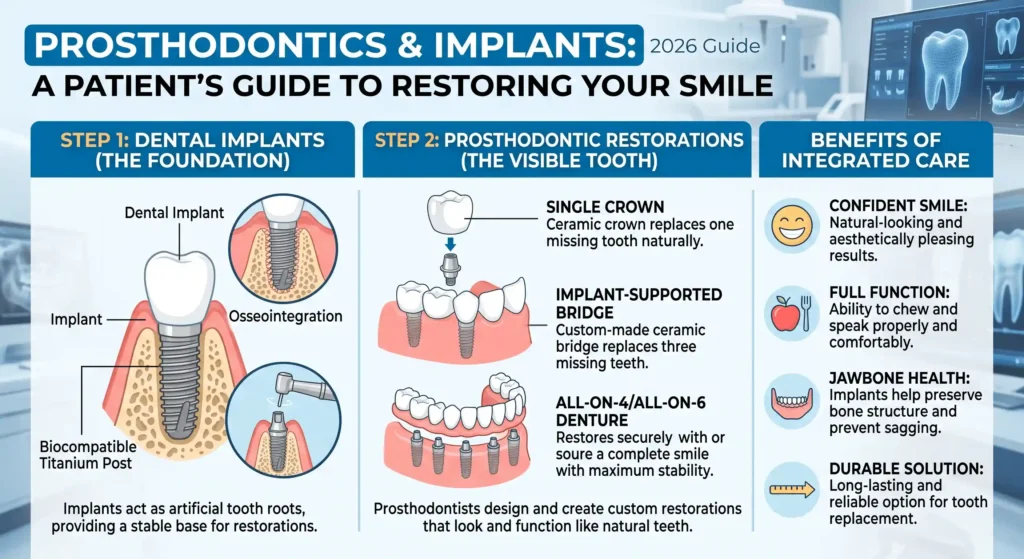
Prosthodontics is the branch of dentistry focused on replacing missing or damaged teeth — everything from a single crown to a full-mouth implant-supported reconstruction. It’s also the category that draws the largest number of international patients to Turkey, because the absolute savings on full-mouth cases are the highest of any dental specialty. This guide covers what prosthodontic and implant treatment involves, how to think about which option actually fits your case, and how 2026 Istanbul pricing compares with the UK and Germany — without pointing to any single clinic.
What Prosthodontics & Implants Cover
Prosthodontics spans a spectrum from replacing a single tooth to rebuilding an entire mouth:
- Dental implants — a titanium (or, less commonly, zirconia) post surgically placed in the jawbone to replace a tooth root, topped with a crown once healed
- Crowns — a cap covering a damaged, weakened, or root-canal-treated tooth
- Fixed bridges — replacing one or more missing teeth by anchoring a prosthetic to the adjacent natural teeth (or implants)
- Removable partial dentures — a clasp-retained appliance replacing several missing teeth, removed daily for cleaning
- Full (complete) dentures — replacing all teeth in an arch, resting on the gum ridge
- Implant-supported overdentures (“snap-on” dentures) — a removable denture that clips onto 2–4 implants for far better stability than a conventional denture
- All-on-4 / All-on-6 / All-on-8 — a fixed, non-removable full-arch bridge supported by 4, 6, or 8 implants per jaw — the most common “full mouth implants” solution for patients missing most or all of their teeth
- Bone grafting and sinus lifts, where insufficient bone volume needs to be built up before implants can be placed (covered in more depth in our companion guide on oral and maxillofacial surgery)
Choosing the Right Option: A Quick Framework
The single biggest cost and outcome decision in prosthodontics is which type of restoration actually fits your situation — and this should be decided clinically, not by budget alone.
- Missing one tooth, healthy neighboring teeth, adequate bone: a single implant + crown is usually the gold-standard option; a bridge is a lower-cost alternative that avoids surgery but requires shaving down the adjacent teeth.
- Missing several teeth in a row: a fixed bridge (tooth- or implant-supported) or a removable partial denture, depending on the gap size, bone condition, and budget.
- Missing most or all teeth in a jaw, adequate bone: All-on-4 or All-on-6 — a fixed, permanent bridge on a handful of implants, generally considered the most cost-efficient entry point into full-arch implant treatment.
- Missing most or all teeth, insufficient bone, and/or budget-constrained: an implant-supported overdenture (2–4 implants, removable) offers dramatically better stability than a conventional denture at a lower cost than a fixed full arch.
- Missing all teeth, not proceeding with implants (medical, budget, or bone reasons): a conventional full denture remains the most affordable option, though with the well-known trade-offs of reduced chewing efficiency and a higher risk of slippage over time.
A trustworthy provider explains these trade-offs and gives you options at different price points — rather than presenting only the most expensive fixed-implant solution as the sole path forward.
Why Istanbul Has Become a Global Hub for This Specialty
- The same premium implant brands used in Western Europe. Straumann, Nobel Biocare, and other internationally recognized systems are widely used in Istanbul — a Straumann implant placed in Istanbul is manufactured to the same specification as one placed in London or Munich.
- In-house CAD/CAM labs. Many high-volume clinics operate their own digital laboratories on-site, which shortens turnaround for crowns, bridges, and full-arch prosthetics from weeks to days.
- High surgical volume. Leading Istanbul implant centers report very high annual case numbers, translating into deep, specific experience with complex full-arch cases, not just single implants.
- Structural cost advantage. As with the rest of Turkish dentistry, lower labor, rent, and lab costs — combined with a favorable exchange rate for GBP, EUR, and USD — account for most of the price gap, not lower material quality.
- All-inclusive full-arch packages. Many providers bundle implants, bone grafting if needed, temporary teeth, the final prosthesis, and logistics (transfers, sometimes accommodation) into a single price — a structure far less common in the UK or Germany, where each stage is typically billed separately.
2026 Price Comparison: Turkey vs. Western Europe
Ranges below are drawn from multiple published 2026 sources. Implant and prosthodontic pricing varies enormously by brand, material, and case complexity — treat this as an orientation guide, not a quote.
| Treatment | Typical range in Turkey | Typical private range in UK | Typical range in Germany | Approx. savings |
|---|---|---|---|---|
| Single implant + crown (mid-range brand) | €400–€900 | £2,000–£4,500 | €1,800–€3,500 | 60–80% |
| Porcelain/zirconia crown (no implant) | €150–€300 | £500–£900 | €400–€700 | 55–70% |
| 3-unit fixed bridge | €400–€900 | £1,800–€5,000 | €1,500–€3,500 | 60–75% |
| Removable partial denture | €150–€350 | £500–£2,500 | €400–€1,200 | 60–75% |
| Full conventional denture (per arch) | €200–€450 | £600–€1,500 | €500–€1,200 | 55–70% |
| Implant-supported overdenture (2–4 implants, per arch) | €1,200–€2,800 | £4,000–€8,000 | €3,500–€7,000 | 60–70% |
| All-on-4 (fixed, per arch) | €2,800–€5,500 | £8,000–£14,000 | €7,000–€12,000 | 60–75% |
| All-on-6 (fixed, per arch) | €3,500–€7,000 | £10,000–£18,000 | €9,000–€15,000 | 60–70% |
| Full mouth, both arches (All-on-4/6, all-inclusive) | €6,000–€14,000 | £16,000–£28,000+ | €14,000–€24,000 | 55–70% |
Why the range within Turkey is so wide: implant brand is the single biggest driver — a budget or generic implant system sits at the bottom of the range, while premium internationally recognized brands with long-term clinical data and stronger warranty backing sit at the top, still well below equivalent Western European pricing for the same brand.
What a Full-Arch (All-on-4/6) Patient Journey Looks Like
Because full-mouth implant cases are more involved than most other dental travel, the process typically runs:
- Remote assessment with a recent panoramic X-ray or CT scan, giving an initial (non-binding) plan and price range.
- First visit (7–10 days): in-person exam, 3D CT scan, any needed extractions, implant placement, and a temporary fixed bridge fitted — so you leave Turkey with functional temporary teeth, not a gap.
- Healing period at home (3–6 months): osseointegration — the implants fusing with the jawbone — happens during this time. This cannot be shortened; it’s biological healing, not a scheduling constraint.
- Second visit (5–7 days): the temporary bridge is removed, final impressions are taken, and the permanent zirconia or porcelain-fused prosthesis is fitted and adjusted.
- Long-term maintenance, ideally with your regular dentist at home for routine hygiene visits, with periodic check-ins with the treating clinic as specified in your warranty terms.
This two-visit structure, months apart, is standard for fixed full-arch implants — be cautious of any provider promising a single-trip “permanent” full-arch solution without a healing interval, particularly if you have compromised bone density or other risk factors your surgeon should assess first.
What to Check Before Committing
- Implant brand named explicitly, with documentation (an “implant passport” or equivalent) confirming the brand, size, and batch — not just “premium implants” as a marketing phrase.
- CT scan reviewed before a firm price is given. Bone volume, not just the number of missing teeth, determines whether grafting is needed and affects the final price — a quote given without imaging is preliminary at best.
- Whether the case is handled by a prosthodontist and/or oral surgeon, particularly for full-arch cases, which typically involve both surgical placement and prosthetic design.
- What “all-inclusive” actually includes — ask specifically whether extractions, bone grafting, temporary teeth, the final prosthesis, and follow-up visits are all covered in the quoted price, or billed as extras once treatment begins.
- Warranty terms in writing — implant failure rates are generally low but not zero; confirm what’s covered, for how long, and whether a return trip is required or a local partner dentist can handle issues.
- Realistic scheduling around the healing period. Don’t let a provider pressure you into a compressed timeline that skips or shortens osseointegration — this is the single biggest determinant of long-term implant success.
- A plan for local aftercare. Full clinical documentation (X-rays, implant brand/size, prosthetic material) should be provided so your regular dentist can perform routine maintenance between visits to Turkey, if any are needed.
Frequently Asked Questions
Are implants placed in Turkey as reliable as in the UK or Germany? Success rates for major, well-documented implant brands are comparable internationally when placed by an appropriately trained surgeon with sound 3D planning — the implant system, surgical protocol, and biology are the same. The variable that matters is the individual clinic and surgeon’s training and case volume, not the country as such.
How many trips will a full-arch implant case actually require? Typically two: an initial visit for extractions (if needed) and implant placement with a temporary bridge, and a second visit 3–6 months later for the final prosthesis once healing is complete.
Can I get a permanent full-arch prosthesis on the very first visit? No reputable provider should promise this for a genuinely fixed, permanent result — osseointegration takes months. Same-visit “teeth in a day” protocols exist and are legitimate, but they refer to fitting a temporary fixed bridge on the day of surgery, with the final prosthesis following after healing.
What happens if an implant fails? Failure rates for major brands are generally in the low single digits. Ask specifically what the warranty covers — replacement implant cost, whether a return trip is required, and the timeframe the guarantee applies for — before treatment begins.
Is a cheaper quote ever a red flag? A quote significantly below the low end of the ranges above, especially for full-arch cases, is a reason to ask harder questions about implant brand, whether a CT scan was actually reviewed, and what’s excluded from the headline price — not an automatic reason for excitement.
This article summarizes publicly available 2026 market data and general best practice for prosthodontic and implant treatment involving international travel. It is not a recommendation of any specific clinic, brand, or surgeon. Any price should be confirmed directly and in writing, based on your own CT scan and a clinical assessment, before you travel.